Water remains one of the most important tools in wildfire suppression. So when a product is added to water, the practical question is straightforward: what does it actually change?
BLAZETAMER380™ is an elastomer polymer-based water enhancer formulated for direct wildfire suppression. It is mixed with water and designed to improve how that water behaves during fire suppression. BLAZETAMER380™ is not simply “more water”, and it is not a fire retardant. It is a water-enhancing fire suppressant designed to help make water work more effectively.
Why enhance water?
Water is highly effective at absorbing heat, which is why it remains fundamental to suppression through engines, hose lines, water tenders, helicopters and airtankers.
Aerial delivery adds another set of challenges. Water travels through hot, turbulent air before reaching the target. Evaporation, drift and droplet breakup can affect how much of a load reaches vegetation and surface fuels in a useful form.
Even after impact, performance matters. The value of a suppression load depends on how effectively the applied water can reach fuels, remain available for cooling and support the tactical objective.
What is a water enhancer?
A water enhancer changes some of the physical characteristics of water so it can perform differently during fire suppression. The U.S. Forest Service describes water enhancers as products that alter the physical characteristics of water to increase its effectiveness, including its ability to adhere to fuels. This is different from long-term fire retardants, which are designed to affect fire behaviour through a different mechanism.
BLAZETAMER380™ is an elastomer polymer-based water enhancer. At low concentrations, typically around 0.2–0.65% by volume, the polymer interacts with the water to create different physical behaviour during application and after impact.
In simple terms, the objective is to make water more effective as a suppression agent.
That means looking at several things:
- How much water is lost before reaching the target? - Water enhancement is intended to reduce avoidable delivery losses and improve useful water at the target.
- How well does it reach vegetation and surface fuels? - Drop behavior, canopy penetration and fuel interaction can influence how useful the delivered water becomes.
- What happens when the mixture reaches the fuel? - Cooling, spreading and contact with fuels are part of the suppression outcome.
- How long can useful cooling continue? - Duration varies with conditions, but water enhancement is designed to keep water available for cooling longer.
- Can it fit existing operations? -BLAZETAMER380™ can be incorporated into a range of ground and aerial delivery systems.
- What is the tactical objective? - Enhanced water is intended primarily for direct attack, rapid cooling and suppression support.
What makes BLAZETAMER380™ different from plain water?
The easiest way to understand the difference is to look at what happens during an aerial application.
1. Evaporation resistance
BLAZETAMER380™ is designed to increase resistance to evaporation. Technical material for the product reports up to 20% greater resistance to evaporation compared with water alone. In result, the water that remains available to cool the fuel is more useful than water that is lost before it can contribute to suppression. This does not mean that BLAZETAMER380™ stops evaporation entirely; instead, it extends the amount of time water can remain available for cooling under fire conditions.
2. Adhesion and fuel interaction
BLAZETAMER380™ is formulated to improve how water interacts with vegetation, canopy and surface fuels after it reaches the target
3. Droplet behaviour
BLAZETAMER380™ changes the physical behaviour of the water mixture, including its resistance to breakup during aerial delivery. The scientific term for this is non-Newtonian behaviour. Meaning the mixture becomes more resistant to breakup during the drop and then behaves differently after impact.
What happens when BLAZETAMER380™ reaches the fire?
Water enhancement becomes operationally meaningful when the mixture reaches the target. The intended sequence is simple:
Deliver → reach → adhere → cool → suppress.
During an aerial drop, the enhanced water aims to resist some of the losses associated with evaporation and droplet breakup.
After reaching the target, the formulation improves the interaction with vegetation and surface fuels and maintains cooling for longer than untreated water.
The technical briefing shows an active cooling period of approximately 30–45 minutes under the conditions tested. Again, this does not mean every drop on every fire will provide 30–45 minutes of cooling. Every operation is different when it comes to fire behaviour, fuel type, weather, application rate, terrain and other factors.
Is BLAZETAMER380™ a fire retardant?
No. This is one of the most important distinctions to understand.
BLAZETAMER380™ is a water enhancer for aggressive, direct wildfire suppression.
A water enhancer and along-term fire retardant perform different jobs and should not be treated as interchangeable terms
Does BLAZETAMER380™ replace water?
No. Water is the base. BLAZETAMER380™ is added to improve how that water performs rather than eliminate the need for it.
Make the available water work harder
Water availability can be constrained by geography, aircraft capacity, turnaround time and access to water sources. Water enhancement is designed to improve the value of the water already available to the operation.
What does this mean for aerial firefighting?
Aviation resources are limited and expensive. Aircraft have finite payloads, and every additional trip takes time. Traditional water delivery can also involve evaporative loss and drift before the water reaches the intended target. BLAZETAMER380™ is designed to address some of those limitations by improving the effectiveness of aerially delivered water.
Of course, adding BLAZETAMER380™ does not magically increase the physical capacity of an aircraft
A 1,000-gallon tank is still a 1,000-gallon tank. The purpose of water enhancement is to improve how effectively that load contributes to the suppression objective.
Where does BLAZETAMER380™ fit in a firefighting strategy?
No single suppression product is right for every fire. Wildfire behaviour is influenced by fuel, terrain, weather, topography, fire intensity and the resources available to respond.
BLAZETAMER380™ is designed for direct wildfire suppression where rapid cooling, knockdown and suppression support are the objectives. It can be incorporated into ground and aerial operations, including engines, water tenders, helicopters, scoop aircraft, SEATs and larger airtanker systems, depending on agency authorization, equipment configuration and operational requirements.
How can BLAZETAMER380™ help answer the operational need?
- Need more useful suppression from the water already available? - Water enhancement is designed to reduce delivery losses and improve how water behaves at the target.
- Need a direct-attack tool rather than a long-term barrier? - BLAZETAMER380™ is designed for rapid cooling, knockdown and direct suppression support.
- Need flexibility across ground and aerial resources? - The concentrate can be integrated through ground mixing, dip-tank arrangements and compatible injection systems.
- Need to work around limited water access or long turnaround times? - Improving the performance of each available load can be operationally valuable when water or aviation cycles are constrained.
- Need a tool that can complement retardant? - Enhanced water and long-term retardant can serve different objectives within the same broader suppression strategy.
- Need technical, safety or implementation information? Product resources can support agency review of handling, equipment compatibility, water-enhancer qualification and operational use.
Integration into Operations
The concentrate can be incorporated into multiple operational systems. The appropriate method depends on the platform, agency requirements, equipment configuration, quality-control procedures and the tactical objective.
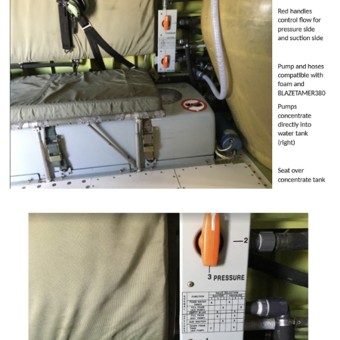
- Ground-based mixing and loading systems
- Helicopter dip tanks and portable water-storage arrangements
- Compatible onboard injection systems
- Engines and water tenders
- Approved aerial platforms with appropriate configuration
Safety, qualifications and environmental considerations
BLAZETAMER380™ has been qualified on the U.S. Forest Service Qualified Products List as a water enhancer since 2012. Product handling, storage and exposure controls are addressed in the Safety Data Sheet. Available product resources also include aquatic toxicity and other technical information for agency review. You can find the Safety Data Sheet along with more Product Resources: Here.
Operational use should follow applicableagency policy, environmental requirements, equipment guidance, approved mixratios and incident-specific direction.
So, is BLAZETAMER380™ just water?
No.
BLAZETAMER380™ starts with water and changes how that water behaves during wildfire suppression.
Its key benefits are:
- Evaporation Resistance
- Fuel Interaction
- Drop Behaviour
- Cooling Duration
- Direct Suppression Value
The takeaway: BLAZETAMER380™ is designed to make the water already available to firefighters work more effectively for direct wildfire suppression.
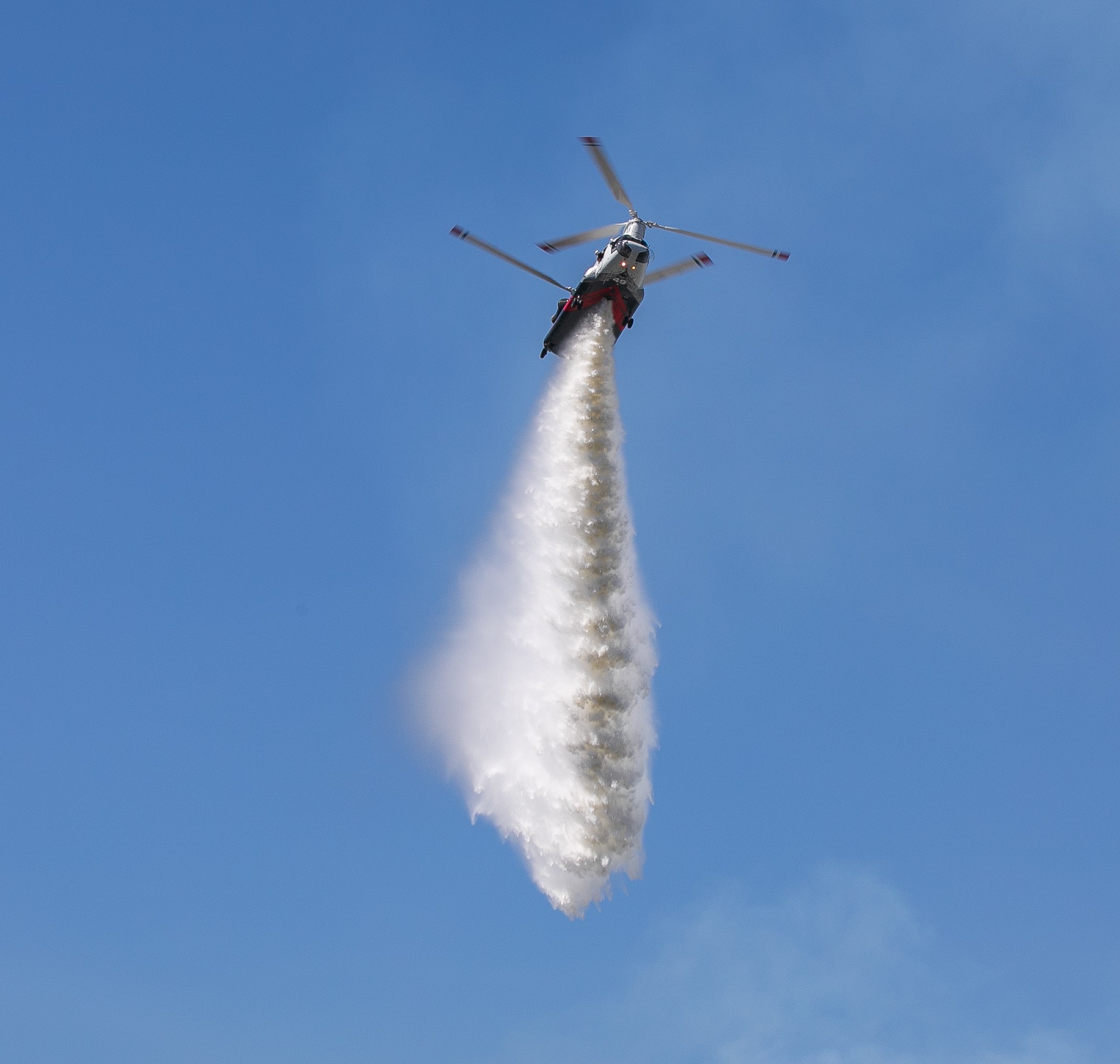
Picture Credit: Ryan Grothe


